One billion real digits of π, laid out as land. Teleport to a number you love, and sign your name where you found it.
Every digit independently verifiable
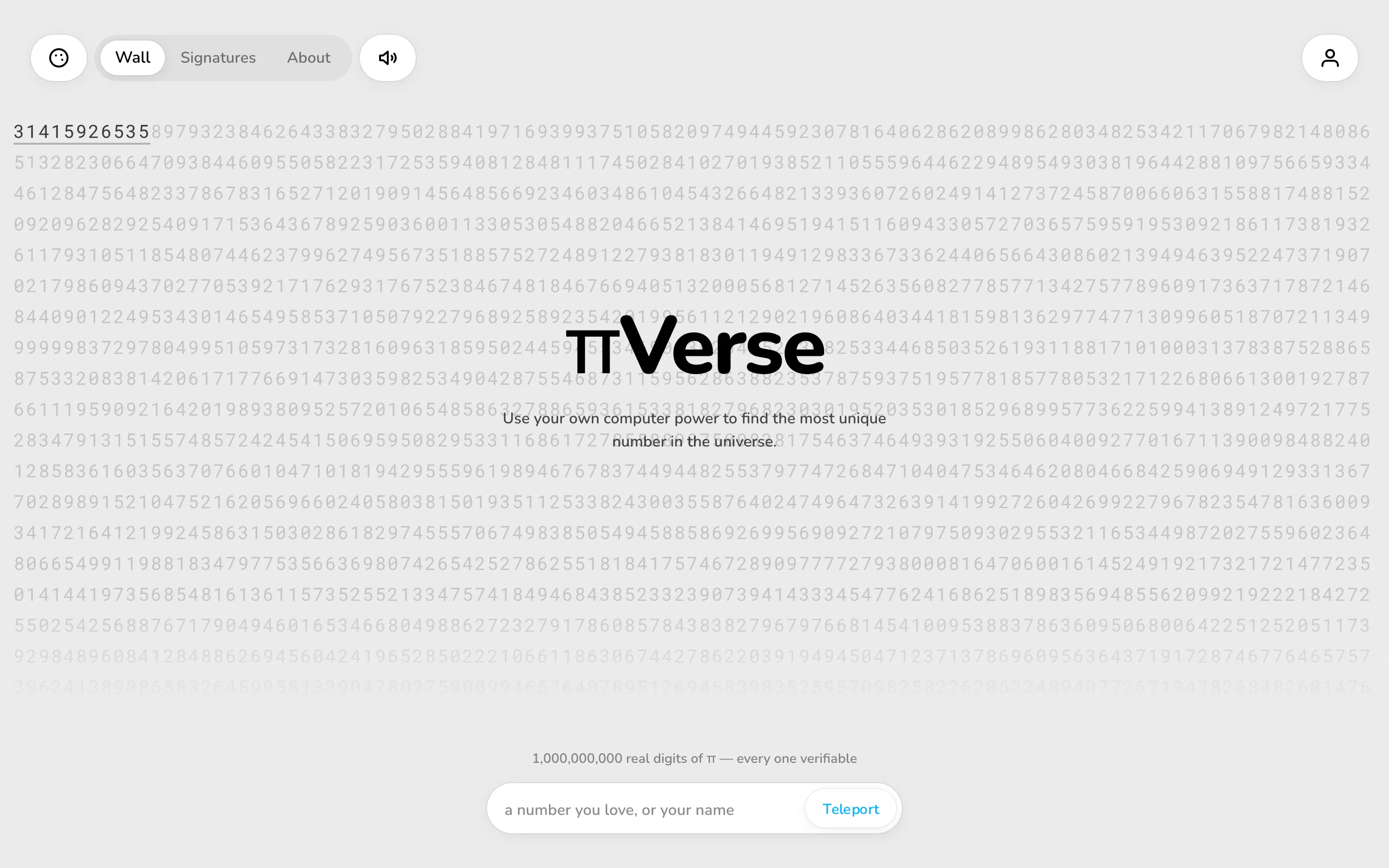
Real π, not a map trick
Every stretch of digits is the actual decimal expansion — recompute it and it checks out. Rarity is handed out by mathematics, not by us.
A signature, not a land grab
Claiming fences nothing off. The same digits can carry many names — but the first finder is always the first finder.
Your number is already there
A birthday, a phone number, the digits you keep noticing — they have been sitting somewhere in π all along. You just haven't visited.
Search runs in your browser
The digits are served as plain static files. Your browser downloads a stretch and scans it; the server is never asked to find anything.
Words become digits first
Each letter turns into its position in the alphabet, two digits wide: a is 01, z is 26. So a name is just a longer number.
Positions in the interface count from 1: π #1 is the digit 3. Every coordinate has its own page at /p/{position}/{length}.
Rarity is only about length
In a sequence that behaves normally, every string of k digits is equally likely. 314159 is exactly as rare as 000000, so the tier depends on how long your pattern is and nothing else.
- Common1 to 5 digits
- Uncommon6 digits
- Rare7 digits
- Epic8 digits
- Legendary9 digits
- Mythic10 or more
A k-digit pattern is expected to appear n ÷ 10^k times in n digits. A long one can show a probability that rounds to zero while you are looking straight at it.
Every signature is checked before it is stored
Signing writes your name next to a coordinate. Before that happens, the digits you claim are compared with π at that position.
Checked against Google's Pi API
The comparison runs against api.pi.delivery first. Only if that service cannot be reached does it fall back to the local dataset.
A mismatch is rejected, not corrected
A claim that does not match is never written. There is no later cleanup pass, because nothing wrong gets in.
You can run the same check
The API is public. One request returns the digits at any position, so nothing on the site asks to be trusted.
$ curl "https://api.pi.delivery/v1/pi?start=0&numberOfDigits=11"
What signing does not mean
- It grants no ownership. π is not owned by anyone, and πVerse does not change that.
- A first-of-pattern mark means first on this site, not first in history.
- The dataset is a prefix of π. A pattern that is not here is not absent from π.
The digits were here before you. You just put your name next to them.